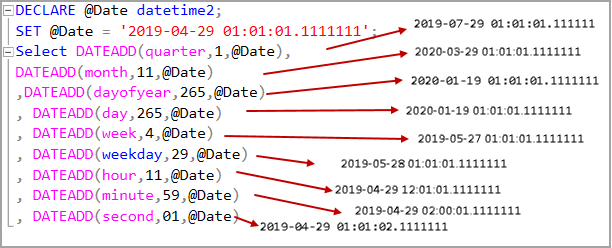
T-Sql Dateadd Business Days. The first step is to create a dataset that will hold the date value. Date_part is the part of date to which the dateadd() function will add the value.
Sql Floor Date Function Review Home Decor from reviewhomedecor.co What is a business?
A company is a type of company which is established to assist a client. The principal objective of businesses is profit, however there are other objectives that can be accomplished by the company. At the end of the day, the primary goal of a company is to fulfill a customer's wants and needs. As Peter Drucker argues, this is the sole true idea of business. The absence of clients means that a company cannot survive.
Internal functions comprise the tasks performed within the company
Internal functions refer to the tasks performed within an organization to accomplish a defined set of objectives. These functions may comprise policies and procedures. For them to be effective, policies and procedures need to be carefully designed, implemented and distributed throughout the organization. The highest management in an organization should convey that the obligation to manage hazards and errors is a very serious matter, and that internal control must be an absolute priority. Furthermore, employees must have a clear understanding of their roles in internal control and have the means to communicate significant information upstream.
Sales and marketing are examples of internal roles. Sales managers are responsible to ensure that their merchandise or services reach their customers in a timely manner. They also have to ensure that they reach all areas where they are targeted. Alongside these essential tasks, internal functions comprise functional support that allows the internal and external business functions to operate smoothly. Managers of these functions supply information to management so that they can make informed decisions.
Internal controls prevent errors to safeguard information, as well as make sure that fraud isn't a possibility. Without internal controls, financial reporting is non-reliable, and operational efficiency can be impaired. Additionally, they may impact the image of the business. So, it's important to establish internal controls in order to ensure the accuracy of the company's financial statements and to prevent fraud and theft.
The measure of profit is an organization's success
Profit is defined in both relative and absolute terms. Absolutely, profit is the amount of profit made for a given time. In terms of relative terms, profit is the quantity of profit that is earned as a percentage of revenues. Profit is an important indicator for businesses as it is a motivator to invest and also take risks.
The goal of profitability is the first priority of any business. Without it, a business will fail. Profitability is determined by two aspects: income and expenses. The term "income" refers to the money that is earned through the selling of products or service. It is not inclusive of the expense of obtaining capital. They are the expense of managing the company.
Profit is the money businesses make after deducting expenses. The higher the profit margin it is, the better its financial position. Another crucial metric is the level of satisfaction of customers. A high level of satisfaction can assist a business enhance its services and products. Mailer newsletters and polls and customer surveys are common ways to collect this data.
Profit does not define success. It's a broad term that applies to diverse businesses. For example, a high street shop may be successful if it is in the position of breaking even, or if it earns the equivalent of a profit of around $2000 per week. The achievement of breaking even is significant for a company in its first year, however, it's not an indicator for an overall success.
Trade cycles make business highly risky
There are four major phases in the cycle of business. Each phase varies in its length and impact on the economy, such as employment rates, inflation, and the consumption of consumers. These cycles are monitored by central banks, and are among the main factors that influence their monetary policy and short-term interest rates. These cycles are characterized by a peak, contraction, and trough. Understanding the different phases of the trading cycle of business can help investors better understand business environment.
The first portion of the trade cycle is known as the expansion phase. The second phase is called the contraction phase. In the stage of contraction the economy reaches its peak growth rate and doesn't continue to grow. The result is that unemployment rates rise, and incomes to sink. The economy also enters into a bear market as investors sell their holdings. The phase of contraction can be caused by an explosive rise in interest rates in the event of a financial meltdown, or over-inflated inflation.
Small businesses in comparison to. mid-sized businesses
There are many ways of categorizing companies. One method is based on the number of employees. A small business is generally defined as having fewer more than 50 employees. A mid-sized company has between 50 and the amount of $1 billion in revenue. Large businesses usually have over 1,0 billion in revenue. While large companies do dominate certain industries, the majority of the work and product is carried out by smaller and mid-sized firms.
The difference between mid-sized and small firms is vital because each business type employs various numbers of people. Although small businesses typically employ less than 100 people, mid-sized organizations could employ thousands of people. Small and mid-sized companies may additionally benefit from different business processes and software.
Furthermore, in addition to these differences, the size of a business may impact the type of work environment it has. Smaller firms may have more flexibility, like improving its communication and decision-making processes. A smaller business may also be able to enact changes faster than a larger company. A small-sized company may provide flexible hours with work-from-home opportunities, and odd bonuses.
One advantage of working with small businesses is that they are more imaginative and focused in their approach to sales. Additionally, small businesses are more likely to try with solutions and try them out to see if their solutions are efficient. They also make decision more quickly and with less complexity than large businesses. Furthermore, small businesses often refer other small companies to their solution if they're happy with their solution.
Subchapter S corporations
Subchapter S corporations are closely linked to the other types of corporations. The basic steps to incorporate a business are the same, but the primary difference is the kind of ownership. In general, individuals are permitted to own stock in S companies. There are limitations on who can be an investor.
If you're considering for launching a new business, you should speak with professionals. Legal and tax professionals can offer you expert guidance. Also, you can sign up for your company's CorpNet Partner Program, a network of companies that provide business establishment and compliance services. In referring clients, they can earn extra cash.
When you're an S corporation, you'll be able to get tax benefits. Subchapter S corporations are not taxed at an corporate level, therefore the earnings you make are not taxed twice. In addition, S corporations don't have to pay taxes on payroll, nor Social Security or Medicare taxes. Because of this, they're considerably more tax-efficient than other types of business organizations.
However, this system has certain disadvantages, among them the fact that shareholders are required to pay tax on all amounts that are distributed to them. Also, it can put pressure on companies to distribute cash frequently and can impact the process of capital formation. Thus, it may not be the right choice for companies that require huge investments.
If any other valid data type is supplied for the date column, then the same data type is returned. Last occurrence of a weekday in a. Select lastname, birthdate, dateadd (year, 18, birthdate) as dateadd from employees;
Then Loop Over The Last Few Days To Get The Result.
If the value of the date is a string literal date value, then dateadd() returns a datetime value. How to add days to date dateadd function with getdate, sysdatetime, current_timestamp. Dateadd examples using all options.
The Westclintech Function Designers' Blog.
Last occurrence of a weekday in a. Here’s a very simple solution in the form of a scalar function. Date_part is the part of date to which the dateadd() function will add the value.
I Can Use The Following Query If I Want To Get The Next Business Day.
This function adds a number (a signed integer) to a datepart of an input date, and returns a modified date/time value. This function takes the same parameters as the 'datepart' function we discussed earlier. Find the number of weeks by taking the floor of the n / 5.
The First Step Is To Create A Dataset That Will Hold The Date Value.
Select lastname, birthdate, dateadd (year, 18, birthdate) as dateadd from employees; This time the issue is as a result of the way that week interval works. Given the complexity of trying to use the existing networkdays function, we created the new function busdays to calculate the.
If Any Other Valid Data Type Is Supplied For The Date Column, Then The Same Data Type Is Returned.
Add 18 years to the date in the birthdate column, then return the date: So if the timeframe is longer than a working week (five days) you can: 09/01/2007 is marked as a holiday in this calendar table.
Post a Comment for "T-Sql Dateadd Business Days"