What Does H1 Mean In Business. “net revenue” is synonymous with “profit.”. H2 = sections to break up content, using similar.
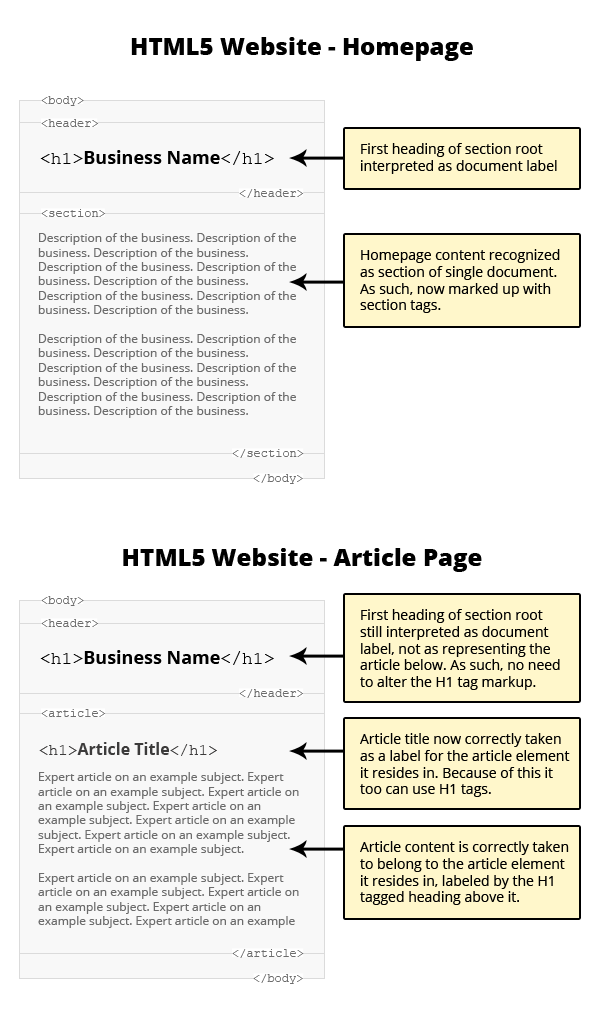
The Truth About Multiple H1 Tags in the HTML5 Era from webdesign.tutsplus.com What is a business?
A business is one type of entity that is created in order to service a client. The principal objective of a company is profit but there are many other purposes that can be achieved by the company. Most importantly, however, the principal goal of a firm will be to satisfy a consumer's desires and needs. As Peter Drucker argues, this is the only real meaning of business. With no clients, a business cannot exist.
Internal functions are activities being carried out within an organization.
Internal functions refer to the tasks that are carried out by the company for the achievement of a certain set of objectives. These can include policies and procedures. To be effective policies and procedures need to be meticulously designed, implemented and shared across the entire organization. The top management of an organization should be able to convey that the accountability for preventing any risks or errors is a serious issue and that internal control must be the top priority. In addition, all employees should realize their roles in internal control , and also have the capability to communicate significant information upstream.
The sales and marketing processes are two examples of internal tasks. Sales managers are responsible to ensure that their merchandise and services reach their consumers at the right time. They are also responsible for ensuring that they can reach all areas they are focused. Alongside these key activities, internal functions include functional support that allows the internal and external business functions to function efficiently. The managers of these functions give information to management so that they can make informed decisions.
Internal controls assist in preventing mistakes help safeguard information and safeguard against fraud. Without internal controls, financial report is not reliable and the efficiency of operations can be compromised. They can also affect the reputation of the company. So, it's important the establishment of internal controls to protect the integrity of the organisation's financial reports as well as prevent theft and fraud.
Profit is the metric used to determine an organization's success
Profit is determined in both absolute and relative terms. In terms of absolutes, profit is the amount of profit that you earn over a period of time. The way to define profit is the quantity of profit as a percentage of revenues. Profit is a crucial measure for businesses since it provides a reason to make investments and take risk.
Profitability is the primary goal of any business. Without it, a company is doomed to fail. Profitability can be determined by two things such as expenses and income. Income is money made from the sales of a product service. It is not inclusive of the expenses of acquiring capital. It is the cost of running the business.
Profit is the financial gain the business earns after deducting expenses. The greater the profit margin higher, the better business's financial situation. Another significant metric to consider is the amount of customer satisfaction. A high level of satisfaction is a good indicator of whether a company can enhance its services and products. Newsletters via email, polls and surveys of customers are all common ways to collect this data.
Profit does not define success. It can mean different things to different businesses. For instance, a large-scale shop might be successful when they break even, and/or when it has an average profit of about PS2,000 per week. Achieving break-even is a major achievement for a business in its first year, however, it's far from an indicator of successful.
The fluctuations in the market make business more risky
There are four main phases in the business cycle. Each phase is different in it's duration and influences the economy, including levels of unemployment, inflation and consumer spending. These cycles are monitored by central banks and are one of the primary factors that shape the monetary policy of their banks and short-term interest rates. The cycle is characterized by a contraction, peak, and the trough. Knowing the various phases of the business trade cycle helps investors in understanding the economic situation.
The initial phase of the business trade cycle is called the expansion phase, and the next phase is the contraction phase. The contraction phase is when the economy has reached its maximum growth rate, and ceases to expand. This causes unemployment rates to riseand earnings to drop. The economy also enters into a bear market when investors sell their holdings. This stage of contraction could be provoked by an abrupt rise in interest rates as well as a financial crisis or massive inflation.
Small-sized companies compare to. medium-sized companies
There are many ways of categorizing firms. One is by the amount of employees. A small company is typically defined as having fewer then 50 staff. Mid-sized businesses typically have between 50 to one billion dollars in revenue. Large businesses are usually above $ 1 billion in revenue. While large corporations can dominate some industries, most of the work and production is completed by small and mid-sized enterprises.
The distinction between mid-sized and smaller firms is vital because each kind of business employs a different quantity of people. Although small companies typically employ less than a hundred employees, mid-sized companies could employ thousands of people. Small and mid-sized enterprises may also benefit from different organizational software and company structures.
Beyond these differences The size of a company could affect the type of workplace it creates. A smaller business might have greater flexibility, such as improving its communication and decision-making process. A smaller business may also be able to implement changes quicker than larger companies. Smaller businesses might offer flexible schedules such as work from home and bonuses that aren't too common.
One advantage of working with small-sized businesses is the fact that they are more innovative and specific in their approach to sales. Additionally, small businesses are more likely with solutions and try them out to see if they are effective. They also take decisions more quickly and in a less complicated way as compared to large companies. Moreover, small businesses will often refer other small companies to their solution if they're pleased with the result.
Subchapter S corporations
Subchapter S corporations are closely connected to the other types of corporations. The basics of incorporating an enterprise are the same and the only difference is the type of ownership. The majority of people are permitted to hold stock in S companies. There are also some rules regarding who is a shareholder.
If you have an idea to establish a company, you should consult with an expert. Legal and tax professionals can offer you expert advice. Additionally, you can join in the CorpNet Partner Program, a group of companies offering business legal and formation services as well as compliance and tax services. By referring clients, you are able to earn extra income.
In the case of an S corporation, you'll reduce taxes. Subchapter S corporations are not taxed at the corporate scale, meaning that your profits are not taxed twice. In addition, S corporations don't have to pay payroll taxes or Social Security or Medicare taxes. Due to this, they're better tax efficient than most types of business entities.
However, the structure comes with few drawbacks. For instance, the fact that the shareholders are required to pay tax for the amounts they are given. Furthermore, it may create pressure for the company to make cash distributions frequently as it can negatively impact the formation of capital. Therefore, it may not be the best option for businesses that need major investments.
What does h1 h2 h3 mean in business? “net revenue” is synonymous with “profit.”. H1 means half year being the first six months of the year.
The H1 Tag Is The One That Comes First And Shows Search.
H1 and h2 are heading formats or syles. What is h1 meaning in business? H1 = main keywords and subject matter, what the overall post is about.
What Does H1 H2 H3 Mean In Business?
Net revenue means an entity’s total revenue less its operating expenses, interest paid, depreciation, and taxes. You are wondering about the question what does ha stand for in medical terms but currently there is no answer, so let kienthuctudonghoa.com summarize and list the top articles with the. What is h1 meaning in finance?
An H1 Error Code Means That There Is A Problem With The Freezer Sensor;
“net revenue” is synonymous with “profit.”. First half of the fiscal year. What do ho and h1 mean in statistics?
H1 Means The Bidder Whose Final.
What does h1 h2 mean? The idea is that if. What does h1 mean in business news us immigration.
“H1” Refers To “The First Half Of A Fiscal Year (April Through September)” And “H2” To “The Second Half Of A Fiscal Year (October Through The Following.
Usually, it means that it shorted. To break it down, remember: 1 (1415 reviews) highest rating:
Share :
Post a Comment
for "What Does H1 Mean In Business"
Post a Comment for "What Does H1 Mean In Business"